
We think of catches first and foremost as songs, but might they also work on instruments? Lutenist Dr Sara Salloum recently gave catches a try with a lute ensemble at the Northern Lute Playing Day 2025. Here she reflects on how she and her fellow lutenists got on…
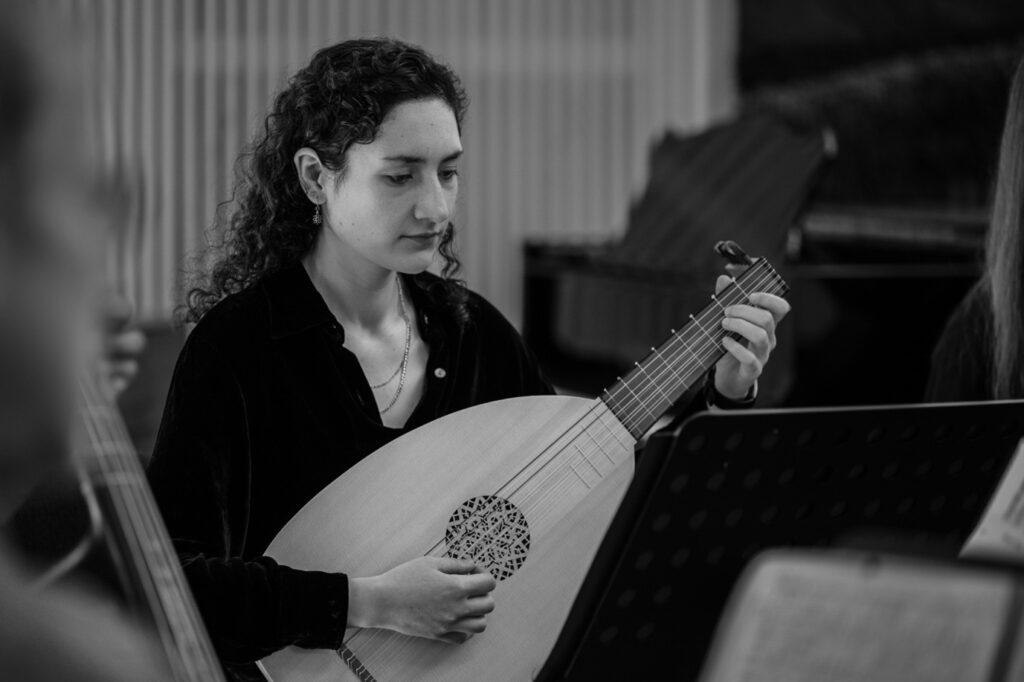
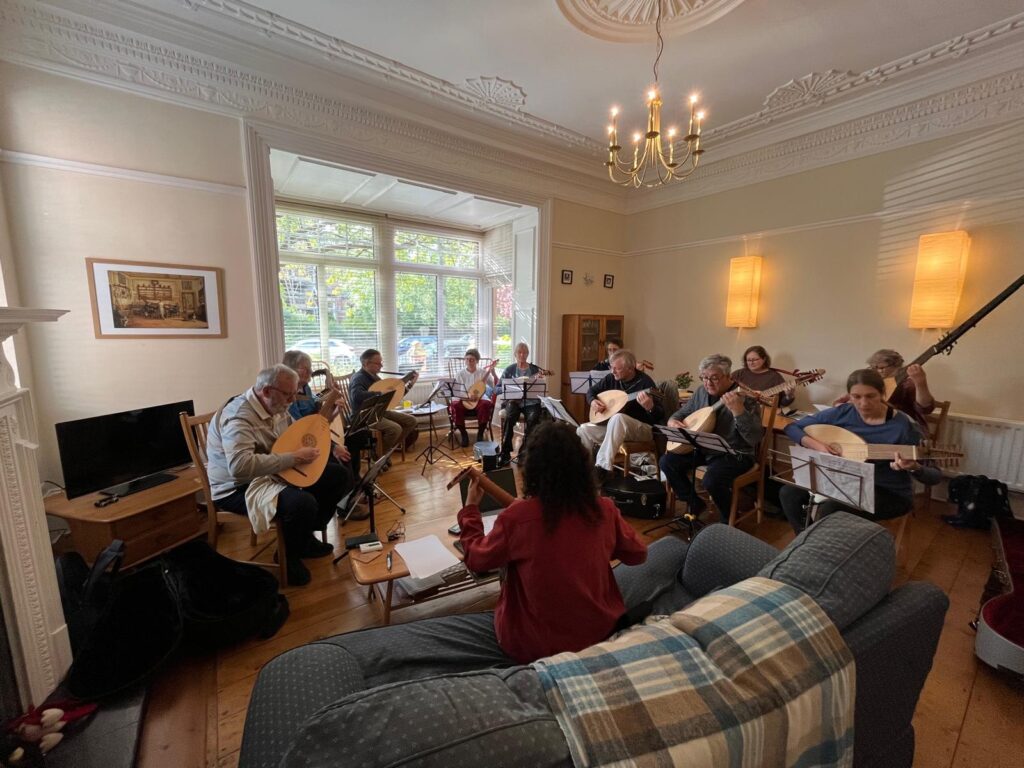
The Lute Society’s ‘Northern Playing Day’ takes place every September to bring together lute enthusiasts from across the north of England and Scotland for an entire day of lute music-making and socialising. I’ve hosted the playing day for the last three years, and in various northern locations – initially in Holmfirth, West Yorkshire, then in the village of Shadwell on the outskirts of Leeds, and this year, at my very own home in Newcastle.
This year, lutenists travelled down from Edinburgh and Glasgow, and up from Leeds, Skipton, and even Bedford to take part in the event. Happily, numbers were higher than ever this year, and there was also a greater interest from beginner lutenists, alongside the more advanced regular attendees, and even a theorbo player and orpharion player were to be among the cohort. It was to be a fabulously diverse class – which was very exciting, but admittedly a bit puzzling when it came to choosing an appropriate repertoire.
Fortunately, my recent involvement with Dr Katherine Butler’s British Academy-funded research project on early modern ‘catches’ sparked my idea to introduce this highly
social and unintimidating repertoire to my class. Indeed, I had seen how
successfully Katherine had introduced this music to people of all ages and
musical stages (to children at Gosforth Middle School, and visitors to Kiplin
Hall, North Yorkshire). Catches are most typically a form of social singing,
and this is how I had always engaged in this repertoire before. I was, however,
intensely curious about the idea of introducing this music to lute players, as
I suspected it would sound fantastic on the lute (the most iconic instrument of
the early modern period). This was the advert I initially sent out:
To my delight 11 lutenists were intrigued enough to give catches on lutes a go!
In advance of the Playing Day, I created a music handout for my lutenists. This consisted of a pack of ten catches, starting with a very easy example and then progressing in a way which introduced new and more challenging musical ideas or techniques. We began with ‘Lord Have Mercy’ in which the rhythms are virtually the same in each line and progressed to more complex melodies such as ‘Sing With Thy Mouth’, dialogue catches such as ‘The Old Dog’ and canons where the parts enter in quick succession succession such as ‘Hey Ho to the Greenwood’.
We started each catch by learning the tune together before splitting into the necessary number of groups to perform the round in harmony (usually 3 or 4). Once my group were comfortable in holding their parts in canon, they began to experiment: with shaping, with ornamentation, with dynamics, and also by singing the words of the catch-tune along with their lute playing. Some players even chose to put their lute down while they sang, enjoying the effect of singing along with an otherwise plucked-sting texture of cascading and circling notes. The repertoire allowed them to take control of the music-making, to experiment, and to enjoy sitting within the sound.
My fellow lutenists enthusiastic about sharing their thoughts about what they learnt, and about their experience of playing this music:
- ‘It’s wonderful that you don’t need vast musical knowledge to perform harmony/music that is quite rich’
- ‘The repertoire is excellent for groups with people of varied levels’
- ‘Great fun in “meeting” other parts when performing a catch in a round. The social aspect of music-making came very easily, even when playing with people I’d never met before’
- ‘There were always safe points to come back into the music if I had become lost for a moment’
- ‘It’s really fun being able to sing and play: for instance, we can sing if notes become lost. You never lose out’
- ‘You get lots out of little’
- ‘There is such intricacy when these catches are played on lutes: musical lines are in “different places” (on different instruments, such as the orpharion, which has a very different sound quality) which gives the overall performance interest, variation, and pleasing changing colours’
- ‘There are moments of poetry’
- ‘Exceedingly unintimidating, I feel welcomed into the sound and the space’
- ‘I feel “in the room” with the sound’
With the Playing Day such a success, Katherine and I are now collaborating to produce a collection of catches adapted for lute players, as well as exploring their potential to be used in school ukelele classes. Watch this space!