
In early March, Hannah attended the HEX conference in Tampere, Finland.
There they presented on their research into the history of Byker’s district heating system. The original 1970s district heating system used Refused Derived Fuel (RDF) pellets to fire its boilers, and offered an innovative way to provide heat to social housing while dealing with some of Newcastle’s domestic waste. The North East Film Archive have a contemporary film about the plant which can be viewed here.
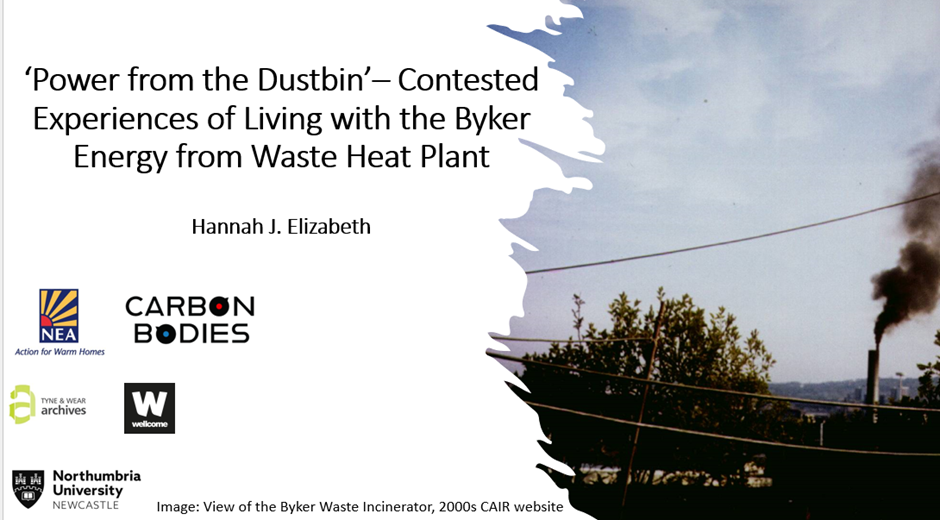
As Hannah’s paper demonstrated, despite its promise, the Byker Energy from Waste Heat Plant had a complicated and controversial history. Residents of the Byker estate experienced problems controlling heat levels within their homes, complained about high bills, and were distressed by smells and smoke coming from the plant. The plant itself had issues too, with the RDF pellet-maker breaking, the RDF pellets producing too much ash, and the boilers themselves not running hot enough.
Issues with the plant came to a head when Newcastle City Council proposed a renovation and replacement of the incinerator with one with larger capacity in 1998. These proposal were met with local objections, partly because of growing awareness of pollution produced by the plant.
Presenting research on the history of a district heating system to an audience in Finland added an interesting comparative context to the paper. What was innovation for Newcastle in the 1970s, and remains fairly rare as a system in the UK overall, is standard across much of Europe, especially the Nordic nations. Between 2000-2018, around 40% of heating in Finland was provided via District Heating systems, in the UK at present its about 2%. Being in Finland was a useful reminder to be attentive to the regional and national context of heat in the UK, but also, to look to the wider histories of heat, energy and design which shape thermal experience. Different nations create, distribute and use heat domestically in a variety of ways and to different standards.